On a tangent to the Watkins Mountains, East Greenland, May/June 2002
"That's what an Expedition means. A long line of everybody." (Winnie-the-Pooh, Expotition to the North Pole)
27 May: Actually, the line waiting to board the Twin Otter is rather short. It consists of Paul, a British Antarctic Survey veteran and his son Scot, Julian, formerly of the British Council, and Kate, the expotition doctor, and myself, a former
Workman Alpinist.
A whiff of dislocation can be sensed. Yesterday, we'd boarded planes in London and Zurich. Today we are at Akureyri airport in northern Iceland, emplaning for Greenland.
Thirty years after the Vikings got to Iceland, a certain Gunnbjörn sighted Greenland after getting blown off course. This was in in 900 AD. Now, to climb the mountain named for that unwilling pioneer, we are repeating his voyage in a single day.
The Twin Otter makes a curving approach to Isafjördur, to take on extra fuel. It rocks in the stiff breeze while arctic terns and oyster-catchers gambol in the reed flats at the end of the runway. In an hour, we’re airborne again and soon Europe's westernmost cliffs are slipping astern.
Less than an hour later, a limitless line of snowy peaks heaves into view. We coast in over unbroken pack ice and follow the line of a giant glacier into the interior. Cameras start clicking noiselessly, drowned out by the rasp of the props.
Basalt cliffs, buttressed by serrated ridges, drift by the wingtip. Bouncing a little in the afternoon thermals, the plane crests the Mangesprekker icefall and noses down the glacier below Gunnbjörn Fjeld. The pilots make a single turn - the fuel budget doesn't allow for sightseeing - and set up a flat approach so that the snow rises gently to meet the skis.
Then the engines open up to drag the aircraft another kilometre or so to the planned camp site. You don't stop immediately because the skis heat up on landing and you need to taxi until they've cooled off. Or they freeze to the snow, as happened to
Que Sera Sera (below), the first plane to land at the South Pole. Unlike
Que Sera Sera, Twin Otter pilots don’t have
RATO to fall back on, so they can’t let that happen.
We unload in a haze of Jet-A fumes. The pilots keep the starboard engine running, on the other side from the doors. As soon as the last rucksack is off, the port engine restarts, and the plane takes off downhill. "This is the moment when you savour the silence," says Paul as the Twin Otter dwindled to a speck.
Soon we’re beating the snow flat for our tents and sorting through the pile of cardboard ration boxes and gear. Now we’ll find out if our organiser has once again lived up to his formidable reputation for logistics. (He has.)
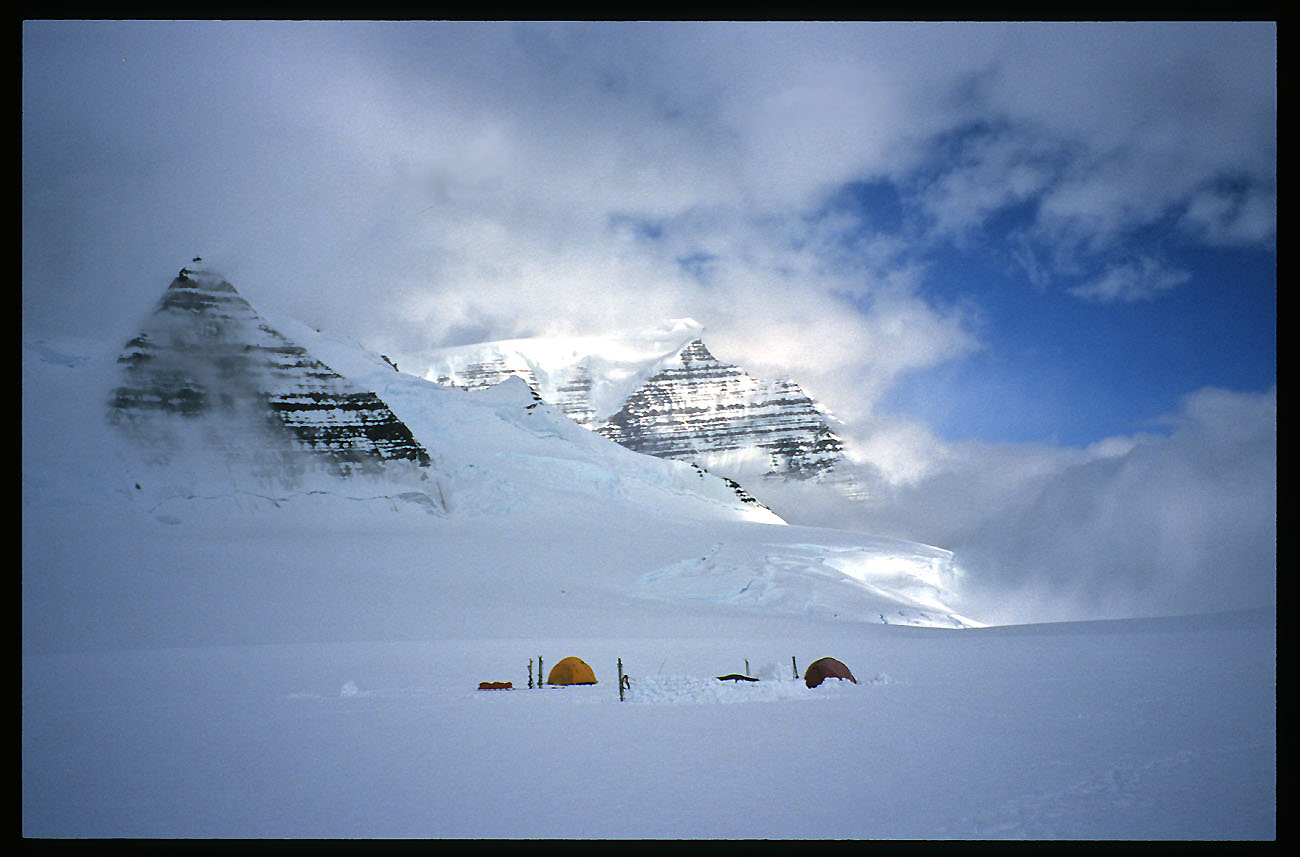
An hour later, three tents have mushroomed in the middle of the glacier and three MSR stoves are roaring for the honour of boiling the first brew of the 2002 arctic mountaineering season. We’re well sorted. I even find my temporarily mislaid Swiss Army penknife with can-opener. This is good, as the ration packs seemed to include quite a few tins of tuna, sweetcorn salad, and stuff of that ilk.
Even in the late afternoon, the sun beats down on the glacier so that we can work in shirtsleeves. It’s completely calm and the snow is soft. So as not to waste the good weather, we'll wait till late evening, suggests Paul, and take some sled-loads of gear towards an advanced camp site. By that time, the snow surfaces will be firming up.
They do. By 10.00pm, when we snap on skis and struggle into the unfamiliar harnesses of the pulks, the sun is dipping below the neighbouring ridge and a distinct chill has come down. We set off towards the glacier that leads up to the north ridge of Gunnbjörns Fjeld. Paul is out in front, angling left to avoid the crevasses that our aerial photos showed as barring the direct line. The rest of us follow, with the three pulks. Yes, a short line straggles across the shadowy expanse. Our expotition is under way.
28 May: Some time in the wee hours, we decide we've had enough of pulk-hauling and the chilly breeze. (No disrespect for the pulks implied, though. These are incredible pulks.)
So we cache the gear, mainly food, fuel, and climbing kit, mark its position with both bamboo wands and fixes on two GPS sets, and ski back down to camp. Sack out at 3.00am. The sun is still below the ridge from our viewpoint, but nearby peaks stay aglow in the ethereal late-afternoon-like light. No sunset or sunrise tinge, because the air is too clear to redden the rays of the sun even when he sits right on the horizon.
Wake late to grey skies and flat light. Poor conditions for glacier travel, so, gratefully, we catch on sleep. We catch up on quite a lot, because nobody remembers much about that day.
29 May: pack up camp, leaving a depot of food, fuel, the rifle, and the sat-phone on the glacier. My tent also stays, in the interest of keeping the pulks light. We move back up to the depot at 2,300m, pick up the contents, and continue up to a flattening of the high glacier at about 2,400m. Repitch the two tents in light snowfall, tiny dry pellets, not flakes.
Christopher Robin was sitting outside his door, putting on his Big Boots. As soon as he saw the Big Boots, Pooh knew that an Adventure was going to happen. (Winnie-the-Pooh)
30 May: we sat at our tent doors, pulling on our Big Ski-Touring Boots. Or, in most cases, struggling to force the inners into the outers. Only I favoured the Whole Boot At Once approach. Which way is better? Perhaps this is one of those questions to which no man will ever know the answer.
Overhead, the sky is blue again, but lenticular clouds hover over the range of peaks opposite. We set off uphill, but "GBF" soon starts to don a cap cloud. "We're not in the business of climbing into lenticulars," says Paul. In thickening conditions, we decide to round the end of GBF's north ridge to see if the mountain offers easier climbing round the back.
A viable route does loom through the mist, but turns out to lead to a satellite peak, not the main summit. So we content ourselves with that and the view out to the sunnier reaches of the coastal range. Heavy snow conditions on the way down, but Scot traces out the way in elegant curves. Let's admit it: he's the only elegant skier in our group. After all, we're British.
31 May: Paul, Scot, Julian, and I ski down to base camp to fetch a couple of pulks-worth of additional food and fuel, plus my tent. We'd discovered over the previous two nights that the three-man tent is ideally sized for two men. (Paul’s Law: a tent will comfortably sleep n-1, where n is the number of persons the manufacturer says it will accommodate.)
Paul calls the organiser on the sat-phone, having repaired a faulty charging connection. Weather bright, cold, the snow still firm at noon, but GBF clouds up later.
1 June: breezy morning. Reveille at 5.00am for a 6.00am departure. Well, 6.40am. Blame the Big Boots. As we climb higher, the lenticulars are breeding like real "Föhn fish" over the neighbouring range. It's minus 10 (as measured by the freezing sensation in our nostrils) and blowing. Expedition mitts are donned. We take turns to break trail through the wind-crusted snow.
We get as far as the glacis below the main summit before GBF performs a vanishing trick into a cap cloud of its own making. We call it a day and ski back to camp as the shoal of lenticulars starts to invade the blue hole over the ice-cap to the west. In the evening, the weather clears again.
2 June: "Dingle weather," in Paul's phrase. That's what they'd say Down South. Crisp, cold, clear. Leave camp at 7.40am, fork left on the glacier, as on the previous day, but today ski through to intercept GBF's north ridge about halfway along its length. This has to be the most elegant way up the mountain, using the skis to gain as much height as possible.
We convene on a basalt outcrop to exchange the skis for crampons. Then on up the ridge on crisp sastrugi, except for one small steep section of blue but pliable ice. Above that, the ridge broadens again so that, at Paul's suggestion, we can stroll up to the summit in line abreast so we all get there at once.
To the west, a row of blunted summits hems in the ice-sheet. Glaciers pour down through gaps in the range, their motion freeze-framed by our mayfly perspective on time. The higher peaks are sculpted from alternating bands of snow and basalt, white and black, like the striped stonework of Tuscan cathedrals. Beyond the mountains, the the inland ice rolls outwards for ever.
The horizon is limited only by the curvature of the earth. The curvature of the earth? Surely, at this modest altitude of 3,700m, that can’t explain the almost imperceptible arc of the horizon that I think I can see. But, without my saying anything, Julian has noticed it too.
The bitter wind that assailed us on the ridge has dropped away, as if by magic. The sun is warm and we can take our time on the summit, taking photos. Not a cloud in the sky, except for a band of haze on the horizon.
3 June: Her Majesty has been on the throne for fifty years. We celebrate with a long day, lasting from 9.20am to 8.00pm. Jetstream clouds may bring a storm later, warns Paul. We ski across the sastrugi'd altiplano between GBF and Lichenbjerg to arrive on the latter mountain's col.
Then we turn left towards the unclimbed 3206m peak on that ridge. Julian clambers out on a rope (over, we suspect, a cornice) to plant the Union Jack (well, a small one) on 'Jubilee Peak', the name suggested by Kate. Julian hums God save the Queen.
After that, we have a go at Lichenbjerg, which has been climbed only once, back in 1935. We get as far as the steepening in the ridge, about 150 vertical metres below the summit. Unfortunately, the steepening coincides with a change from good cramponing snow to glass-hard blue ice. Paul runs out some rope, cutting steps as he goes, but it’s clear that a second ascent of Lichenbjerg, or at least a safe one, is going to take hours of step-cutting and general faffing about. We’re not in the step-cutting business, we decide, as we turn back. Though the summit, a basalt castle rising out of a curving snow arete, is tantalisingly close.

Back on the col, Kate suddenly drops thigh-deep into a small crevasse. We were warned back in the UK about the cracks that run along ridges parallel to the crest on arctic mountains. Something to do with the sheer weight of ice, as it drags away from the ridgeline. We ski down to camp in lengthening shadows on the glacier. Above the western ridge hangs an iridescent cloud. The jetstream clouds have dissipated, without bringing on a storm.
4 June: Good pulking weather for moving the whole ensemble back to base camp. Using snowstakes and slings, Paul rigs brakes for the pulks but these prove unnecessary – we can snowplough and even slalom our skis a bit with these incredible pulks in tow.
It's now the custom of this expotition to greet each other with "Top of the Arctic to you" every morning. Kate says it with such a nice mock-Irish accent. An ancestor of hers was a pony-handler on one of Scot's expeditions.
In the afternoon, Paul, Scot, Julian, and Kate sort through their ration bags, picking out the less desirable items. We've found that, except on really strenuous days, our appetite for Mars Bars is quite limited. More in favour is the salty stuff, such as the soups, the salami sticks, the cheese, and the incredible Pringles.
I leave my rations as they were packed, fresh from some Lakeland Asda: "The appetite of the barbarians was voracious yet indelicate," as some fusty old historian puts it. Yes, that's me. Indifferent except on one point: inexplicably, some of the bags don't contain coffee sachets. Gallantly, the others offer some of theirs in order to prevent me from slipping into hypo-caffeinia. Dear friends, how can I ever repay you? Perhaps in tea-bags, they suggest. Done!
A little Consideration, a little Thought for Others, makes all the difference. (Eeyore in Winnie-the-Pooh)
In the afternoon, cirrus overspreads the sky. Perhaps because it rides lower than in more southerly climes, the fall streaks are clearly visible as they sift down from the parent clouds.
5 June: cloudy, but we plan a rest day anyway. After breakfast, a small bird (snow bunting?) flitters past. Later, Paul and I reconnoitre the route out towards the 'untrodden glacier', our next objective.
On the way, we came across the tracks of an arctic fox. The paw prints (about husky size, opined Paul) ran straight as a die from one corner of the glacier diagonally towards the other. But what could a fox be doing here, in this vast and chicken-less expanse?
Soon afterwards in the flat light we meet an unexpected crevasse that bars the way for a considerable distance. Clearly, we'll have to end-run this tomorrow by diverting far to the left. Paul favours a further reconnaissance the next day, but accepts Julian's counterproposal which is to move on with the pulks, but with two people out in front finding the way.
Weather clears in the evening, although a backbow (circumzenithal arc) hovers in the lingering cirrus. In other countries, backbows are a reliable precursor of bad weather, but we're getting wary of making predictions. The hobbyhorsical clouds are always one step ahead of our speculations.
"I shouldn't be surprised if it hailed a good deal tomorrow," Eeyore was saying. Blizzards and what not. Being fine today doesn't Mean Anything. It has no sig - what's that word? Well, it has none of that. It's just a small piece of weather." (The House at Pooh Corner)
6 June: Yet it was still bright when we start off next morning, except for a fast-rising line of stratus behind us. Paul and Julian go off ahead to find the route, while Scot, Kate, and I take the pulks in tow. Just as the glacier starts to fall away, we meet Paul and Julian coming back. The light was already too flat for travelling, they say.
So less than two hours after starting, we pitch camp again under the bulk of the mountain at the corner of the glacier. I build high snow walls round my tent in an attempt to invoke sympathetic magic against a storm. Desultory snow showers fall in the afternoon, while Paul and Julian exploit a few gleams of light to extend the route a few more kilometres. Scot goes along too, to represent the Pulk-Pullers' Union, he said. Then the visibility really does fade.
We settle in our tents to read and fester while a sheet of stratus pours over the bounding cliffs of the 'untrodden glacier' opposite.
7 June: gleams of light across the glacier as we cook breakfast (semolina and hot chocolate), but then snow sets in again. Heavy snow later in the morning, even as shafts of sunlight wander uncertainly about the glacier. In the afternoon, Scot and I make a run back to base camp to fetch more food and fuel. Going up, we ski in and out of cloud banks that are rolling down the glacier. Sometimes, peaks loom forth, once the view is reduced to a sunny gleam of light on snow that divides two featureless swathes of grey.
A curious phenomenon, which we notice on other days as well: whenever snow is falling, the tents heats up markedly - to a sauna-like 30 degrees this afternoon. Then the temperature drops back around ten degrees immediately the snow stops. Can't think of a mechanism for this.
8 June: at 3.00am, a brilliant midnight sun has just emerged from the peaks to the north. On the slope in front of us, an 'icebow' glitters on the snow crystals. With freezing hands, I occult the sun with a ski and take a photo. The icebow phenomenon isn't uncommon. We see it again at the very next camp site, again when the sun was low on the horizon.
9.15am: we start a 10km pulk haul to a new camp site near the snow dome at the entrance to the 'untrodden glacier'. On the way, veil clouds ride up from the direction of the coast - the bad weather seems to come mainly from the east here - and it starts to snow as we pitch the tents. The others go to climb the snow dome, but I had to repitch my tent, door well away from the wind. This was a wise precaution because ...
9 June: … wet snow falls all of the 'night' hours and most of the day too, melting as soon as it hit the tents. At 5.00am, a brief gleam of light appears and a raven takes the chance to drop by - heard by me and seen by Paul as it inspects the campsite. Apparently it doesn’t find anything to its liking, for it soon flies off again in the direction of the coast.
Continuous heavy wet snow from noon. We fester variously. I read Anna Karenina. Paul and Scot play draughts on a board drawn on the back of the map with pieces represented by the (unpopular) chewy sweets.
At 9pm, the stratus suddenly rolls away to reveal the 'untrodden glacier' bathed in a pure evening light under a ragged edge of cloud. Tiered lenticulars hung over the scalloped whorl of the snow dome. To the west, a golden corridor leads between the mountains towards the interior.
10 June: we set off at 9.15am for the end of the 'untrodden glacier'. As we go, the cloud cover starts to break up so that shadows and stripes of sunlight go racing over us along the snow. This helps the illusion that we, like Alice, are “moving under skies/Never seen by human eyes”.
To be sure, the area has been mapped and photographed from the air, but we’re the first to establish ground truth. The snow slopes gently upwards to the sphinx-like mountain guarding the end of the glacier, where we arrive around 2.30pm.
There’s an impressive view over an ice-fall under the rump of the sphinx. The drop is more than a thousand metres. Glacier lassitude and a lack of kit (we are travelling light) cause us to abandon the first ascent of the sphinx to some future party. A pity, but, as it is, both Kate and Scot are suffering from ill-fitting boots by the end of the day. A long, hot slog back over the melting snows of the glacier.
"When you wake up in the morning, Pooh," said Piglet at last, "what's the first thing you say to yourself?"
"What's for breakfast?" said Pooh. "What do you say, Piglet?"
"I say, I wonder what's going to happen exciting today?" said Piglet.
Pooh nodded thoughtfully.
"It's the same thing," he said. (Winnie-the-Pooh)
11 June: Julian starts his MSR even earlier than usual, signalling his intention to tackle Big Bad Peak (pt.2868) above the camp. I knock back an extra cup of coffee in case the day should become more exciting than usual.
The wet snow causes somebody's skins to work loose from their skis. This triggers the question which type of skins work better - the ones with end fittings or the ones without? Night-cap debates like this liven up all good expeditions. You can find the prototype in Boswell’s
Journal of a Tour to the Hebrides with Samuel Johnson, LLD: 'Sir, I had this custom by chance; and perhaps no man shall ever know whether it is best to sleep with or without a night cap.'
Unfortunately, cloud soon rolls up from the east. As we ski higher, disquieting sussurations ran ahead of us through the snow as the top surface settles. While the peaks of the eastern range vanish one by one into the clag, Paul digs snow-pits to gauge the stability of the slopes.
Worryingly, the 40cm or so of new snow hasn't bonded to the older layer. We make it to the col but the final snowpit shows that the Big Bad Peak’s snows overlay two layers of blank ice. That is enough warning for Paul, Scot, and myself, but Julian and Kate opt to try to find a way through the rocks to the ridgeline.
As the weather seems to be clearing, we then decide to tackle pt2824, a much easier proposition than The Big Bad One with which it shares a col. Less than an hour of determined postholing bring us to the summit. More 'woomfing' from the snow as Scot leads across to a subsidiary peak. Reassuringly, one of the gendarmes on a nearby ridge bears a curious resemblance to a Madonna and child.
Meanwhile, Julian and Kate seem to have treed themselves in a niche between two rock bands. We get back to the col in time to welcome them back from their bold foray. Julian reports that the rock had been "loose but not crumbly". Thank goodness for that then.
12 June: at 1.00am (local midnight), beautiful soft light is filtering through the lenticular clouds. Dead calm, with purple shadows lying athwart the untrodden glacier.
Bright start to the day, but exactly as on the previous day, cloud comes in later and it gets sultry. We try three ways up a nearby peak but are defeated by the slush on all of them. Our last try leads up a dramatically weathered rock ridge. The rock is both crumbly and loose. You can crush some flakes in your hand.
A white gull (ivory gull?) circles over the camp once, then makes off hastily. Paul and Scot phone home via Immarsat to get the results of England v. Argentina.
13 June: weather fine for our move back to base camp. Unfortunately, this means a long, hot pulk-haul through the noonday sun. Paul and Scot are delayed when a bolt falls off their pulk traces, necessitating a field repair. Later, two ivory gulls circle over us.
14 June: we move on up the glacier to the head of the valley, placing the new camp within sight of the icefall facing the coast. At first, we seem to be headed for a blank gap between mountains, as if about to ski off the edge of the world. Then, gradually, three nunataks start to pierce the horizon, like stones in a Zen sand garden.
4.00pm: Paul makes a recce to the other side of the glacier, to scope out new route possibilities. Like Lhotse, the mountain at the edge of the massif is streaming a plume of cloud. Unexpectedly, we come out on a balcony with a view of this ice-draped bastion.
15 June: Julian now has his eye on Pt 2784, a snowy peak on the edge of the big escarpment. We ski for several hours up the easy part of the glacier, then debate whether to go on. The crevassing above does not reassure.
But the sun decides matters, by making the snow too slushy for us to tackle the next steep slope. Instead, we ski down the glacier to a vantage point from which we could ogle the huge and serrated ridge across the valley. One day that ridge will become one of Greenland's last great mountaineering problems. It looks magnificently loose. Crumbly too, I shouldn't wonder.
16 June: we plan to start early for a last peak-bagging foray up the Cone glacier, but the weather socks in by 4.00am. A brief brightening around noon lures me out, but white-out descends 200 yards after I leave camp.
In their tent, Paul and Scot have graduated to chess, though with an added element of Kim's game. The main challenge is to remember which flavour of sweet stood for which piece. Paul is also moved to interview himself for 'Arctic TV' on the MSR Lean Burn Olympics: "You have to become the fuel," he advises would-be challengers.
17 June: back to base camp, to prepare for 'uplift day'. A bright morning quickly turns cloudy. The evening chill is relieved by an Xmas pudding, that worthily meets its destiny in a pan of blazing whisky. No fuel economy here - it took more than an hour's simmering on the MSR to heat the thing up. Thanks, Mum.
18 June: a lazy morning preparing for uplift by the Twin Otter, which is scheduled to arrive around 3.30pm. Mild panic ensues when the aircraft arrives overhead half an hour early, having failed to drop off its inbound passengers (two Brits) owing to cloud over their intended landing zone. A rush to pack up the last tents and load everything in a blast of propwash and jet fumes behind the idling turbines.
Then out over the mountains and the coast. The pack ice is more broken up than three weeks previously, but the coastal ranges are already far behind when we overfly its eastern edge out to open sea.
Ahead, Iceland lies hidden in layer on layer of cloud. Heavy turbulence as we let down into Akureyri, but rain and wind don't delay the 7.55pm flight to Reykjavik. This Fokker is chokka: there's not a single empty seat. By ten, we’re sitting down to a foaming tankard in the badlands of Reykjavik. Just one each, mind: foaming tankards come refreshingly expensive in this city.


 My new house is nearly finished and is really a splendid affair. I feel quite proud of it. For the sake of having all the paint paper &c healthfully dry, I shall not enter it until about Oct. 1st. I forgot to tell you that during my trip to Hakusan, I saw enormous quantities of raw silk, tobacco, cotton, indigo, and tasted the new corn and potatoes at many places.